


SAP Joule, explained properly
Joule stopped being a chatbot some time ago. It is now a layered system of workspaces, role-aligned assistants, autonomous agents, and a grounding layer built on your own SAP data. Here is how the pieces actually fit together, and what each one costs.
What SAP Joule actually is
SAP Joule is SAP's AI layer for getting business work done, not a single assistant. It combines an intent-based workspace called Joule Work, more than 50 role-aligned Assistants, autonomous Agents that execute multi-step tasks, over 1,300 Skills that perform the individual actions, and a grounding foundation made of the SAP Knowledge Graph and SAP Business Data Cloud. You state an outcome. Joule assembles what is needed to reach it.
The distinction that matters most: a generic AI gives you an answer, while Joule is designed to complete the work and show you what it did. Every action carries your identity and your permissions, so an agent can only touch what you were already entitled to touch. If you want the shorter narrative version first, our overview of what Joule is and why it matters covers the ground more gently, and SAP's own Joule product page is the primary vendor source.
The six layers of the Joule stack
Select a layer to see what it does and why it exists. Read top to bottom and you follow a single instruction from intent all the way down to grounded execution.
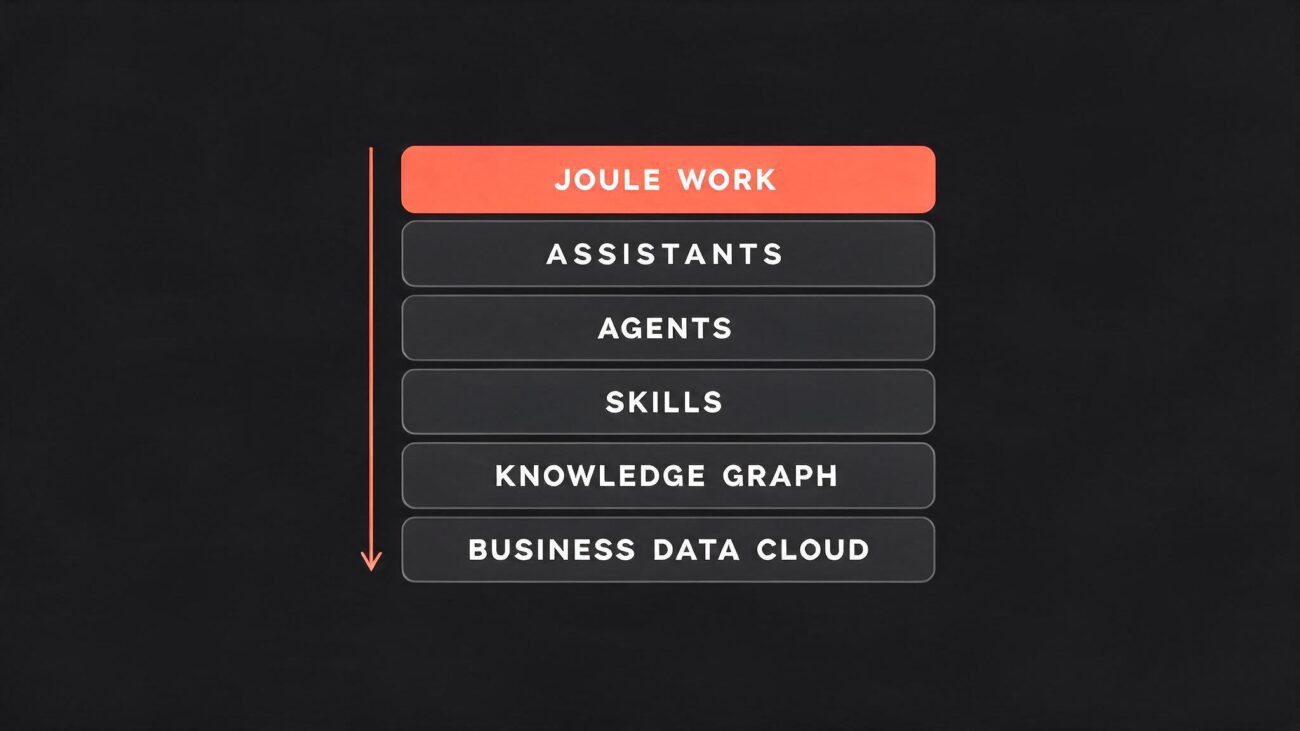
Swipe for all six layers
Joule Work
The intent-based workspace. You describe an outcome and Joule assembles the data, workflows, and agents required. Available as a web client, a mobile application, and a standalone desktop solution.
- Conversations for natural language
- Spaces built around one business outcome
- Develop as the entry point into Joule Studio
Three surfaces, one experience
Joule Work does not replace your SAP applications. It overlays and orchestrates them, so you work in one place instead of moving between transactional screens.
The primary surface
Where most day-to-day work with cloud SAP applications happens, through Conversations and Spaces. Available in Early Adopter Care. SAP has given both H2 2026 and Q4 2026 for general availability across different materials, so treat Q4 as the safer assumption.
Continuity away from the desk
An evolution of SAP Mobile Start. Monitor agent activity, respond to requests for human input, and stay connected to active Spaces. Generally available.
Work outside SAP
A distinct desktop surface that operates at machine level rather than inside SAP applications. It works with local files and desktop applications, and needs no SAP system connection to get started.
Five autonomous domains, 50+ assistants
Each assistant is mapped to a role and coordinates its own set of agents. Pick a domain to see representative assistants, how many agents sit behind each, and the value SAP attaches to them.
Also in this domain: Billing Assistant, Financial Planning Assistant, Tax and Compliance Assistant
Read these numbers carefully. They are SAP's own targets and projections, not measured customer outcomes, and SAP labels them indicative. The stated sources are SAP Value Advisory industry benchmarks together with 2026 BCG and KPMG analysis. Results depend on landscape, adoption approach, and depth of integration, and SAP's own materials give different KPIs for the same assistant in places. Availability spans general release, early access, and planned releases across 2026.
How agents actually run
An agent plans the steps needed to reach its goal, executes them by invoking Skills, monitors the result, and adapts if conditions change. It is triggered in one of three ways.
Conversational
You ask directly in Joule and the agent responds, handling things like expense approval or purchase order creation.
Embedded
The agent works inside the application you are already in, surfacing suggestions and acting without pulling you out of context.
System-triggered
The agent runs in the background from a business event, schedule, or signal. It can monitor policy changes and propose action before anyone asks.
The constraint that makes this safe: across all three modes, every agent action carries your identity and access permissions. An agent cannot reach data or trigger a process you were not already entitled to.
1,300+ Skills, five types
Skills are the atomic action layer. They are deterministic, so the same input produces the same output every time. Agents chain them together into workflows.
Example prompt:
Create a purchase order for vendor 12345Example prompt:
What is the delivery status of order 9876?Example prompt:
Take me to the cash position report in S/4HANAExample prompt:
What were the top three cost overruns last quarter?Example prompt:
Start the approval workflow for this requisitionGoverning agents at scale: the AI Agent Hub
Once agents multiply, visibility becomes the problem. The SAP AI Agent Hub is the central view over every agent in your landscape, including SAP-built agents, custom agents from Joule Studio, and third-party agents from providers such as Microsoft, Google, AWS, and ServiceNow. As of mid-2026 SAP states it already manages more than 130,000 agents across 150 or more customers.
Discover and provision
Find agents in SAP's catalogue, your own library, or connected third-party systems, then deploy them with the right entitlements.
Plan and build
Define goals, permissions, triggers, and workflows. Architecture context from SAP LeanIX is surfaced during creation to inform design.
Observe and analyse
Every decision an agent makes is logged and traceable, with performance metrics, exception rates, and execution telemetry available.
Secure and govern
Apply identity and access controls, verify agents and MCP servers, enforce compliance policy, and keep audit trails.
Optimise and decommission
Refine behaviour from performance data, and retire agents that are no longer needed with audit history preserved.
Joule Studio: building your own agents
Joule Studio is where organisations build agents that reflect their own processes rather than SAP's standard ones. The 2026 release moved it toward intent-based development, where a plain language description generates the implementation stack around it. We wrote separately about building AI agents for real business workflows if you want the practical view.
Describe, then refine
A natural language description can produce requirements, technical specification, code scaffolding, workflow logic, evaluation suites, and multi-agent orchestration definitions.
No infrastructure setup
A fully SAP-managed version removes provisioning and BTP configuration, so analysts and process owners can build and deploy without platform work.
Pro-code where needed
Support extends to agentic frameworks including LangGraph and LlamaIndex, plus an embedded n8n environment for visual multi-agent orchestration. SAP's materials name slightly different framework sets, so confirm your specific one before committing.
Agent to agent
The A2A protocol is bidirectional, so third-party agents can call Joule Agents natively inside enterprise processes rather than only being called by them.
What Joule actually costs
This is where most confusion sits, partly because the model is mid-change. The clean way to think about it is a split between what is included and what scales with the work performed.
| Layer | Commercial treatment | What you need to know |
|---|---|---|
| Joule Base | Included | Free with a qualifying SAP cloud subscription, but it must be entitled first by adding SKU 8019544 at zero cost, which accepts SAP's AI terms. Holders of AI Units under SKU 8019164 skip that step. |
| Assistants | Experience layer | Part of the Joule experience and included with your subscription. SAP states that RISE with SAP customers have three assistants activated within their first year at no additional cost. The agents those assistants coordinate are what carry ongoing cost. |
| Agents | Consumption | The centre of Premium AI. Each agent action consumes 0.02 AI Units in 2026, and total consumption depends on how many actions a task requires. |
| Custom agents | Free to build | Design time in Joule Studio is free within fair-use limits. Runtime is billed on resource consumption, though a time-bound promotion keeps custom agent execution free through the end of 2026. |
| Joule for Consultants | Per user | The stated exception. It stays user-based at 35 AI Units per user per month because its value tracks individual productivity rather than autonomous process work. |
Rough agent consumption estimator
A task is rarely one action. Move the sliders to see how quickly agent work accumulates against the 0.02 AI Units per action rate.
Indicative only. Actual consumption varies by agent and by the work each task performs, and this does not include base subscription, Joule Studio runtime, or any other AI service. Use it to sanity-check scale, not to budget.
SAP has signalled a phased rollout of the new Premium AI model during Q3 2026, with most generative AI features moving into Base AI and the existing per-user packages being phased out. Check the SAP Business AI Feature Catalog in SAP Discovery Center and SAP's Business AI pricing page for current status before committing to numbers.
Where things stand and go next
Joule Work mobile is generally available. Joule Base is included with qualifying cloud subscriptions once entitled. More than 1,300 Skills are live across the SAP portfolio.
Joule Agents were planned for general availability in SAP Ariba Intake Management and SAP Ariba Contracts. On the SAP Fieldglass side, SAP's own materials place the Services Procurement Assistant later, around September 2026, so confirm scope before assuming it shipped together with Ariba.
Phased rollout of the new Premium AI commercial model begins. Agents become the centre of Premium AI, most generative features move to Base AI, and per-user packages start being phased out.
General availability planned for the Joule Work web client, though SAP materials give both H2 and Q4 2026. Joule Work Desktop gains connectivity to SAP systems and Spaces, becoming a fully integrated part of the stack.
The promotional window closes on free custom agent runtime, and on the free Joule Agent Runtime confirmed for Ariba and Fieldglass customers.
What this means for quoting and SAP CPQ
As SAP CPQ experts who work on nothing else, this is the part we get asked about most. The honest summary is that Joule raises the value of a well-built configuration and exposes a badly built one.
The Autonomous CX domain
Deal qualification, sales, order management, and case management assistants already coordinate agents in this space, and SAP has announced a Quote Creation Agent that turns email requests into ready-to-send quotes.
Agents inherit your data quality
An agent assembling a quote relies on the product rules, pricing logic, and approval thresholds already configured. If those carry years of undocumented exceptions, the agent will reproduce them faithfully and faster.
Not a fix for a weak setup
Adding an AI layer over a configuration nobody fully understands does not simplify it. In our experience the sequence that works is to clean the rules first, then automate on top of them.
Know what you have
Before planning agent adoption, it is worth documenting how your quoting logic behaves today, including the exceptions that live only in the configuration.
Questions we get asked
Compiled from SAP Learning course material, SAP Help Portal documentation, and SAP announcements current as of July 2026. SAP's AI commercial model is changing through 2026, so verify current terms before making commitments.
Wondering whether your SAP CPQ setup is ready for any of this?
We are a two-person team that works only on SAP CPQ, and both of us started at CallidusCloud on the original product team. If you want a straight answer about what your configuration would and would not support, that is a conversation worth having before you plan an AI roadmap around it.
Book a free consultation See our SAP CPQ health check